
If you’re thinking about dropshipping on Walmart Marketplace, you’re not alone. It’s one of the fastest-growing platforms for third-party sellers, and the profit potential is real. But here’s the thing: Walmart doesn’t mess around when it comes to their seller policies. One wrong move, and you could wake up to a suspended account and lost revenue.
I’ve seen too many sellers learn this the hard way. So let’s break down exactly what Walmart allows in 2026, what will get you banned, and how to protect your account while scaling your business.
What Walmart Actually Allows in 2026
Let’s start with the good news: dropshipping is allowed on Walmart. But it’s not a free-for-all. You need to play by their rules, and those rules are pretty specific.
Here’s what you can do:
You must be listed as the seller of record on all transactions. That means your business name appears on invoices, receipts, and all customer communications. Walmart wants to know who’s responsible if something goes wrong.
Every order needs to ship on time with valid tracking information uploaded to the system. No exceptions. Walmart tracks your shipping performance closely, and late shipments hurt your metrics fast.
You can only work with approved suppliers or authorized distributors. Retail arbitrage? That’s a no-go. Your suppliers need to be legitimate wholesalers who can provide proper documentation.
All returns must come back to your address or an approved third-party logistics (3PL) warehouse. You can’t have customers sending items back to your supplier’s address. That’s a red flag.
Your product listings need to be accurate. The title, description, images, price—everything must reflect what the customer actually receives. Misleading listings don’t just hurt your reputation; they violate Walmart’s terms.
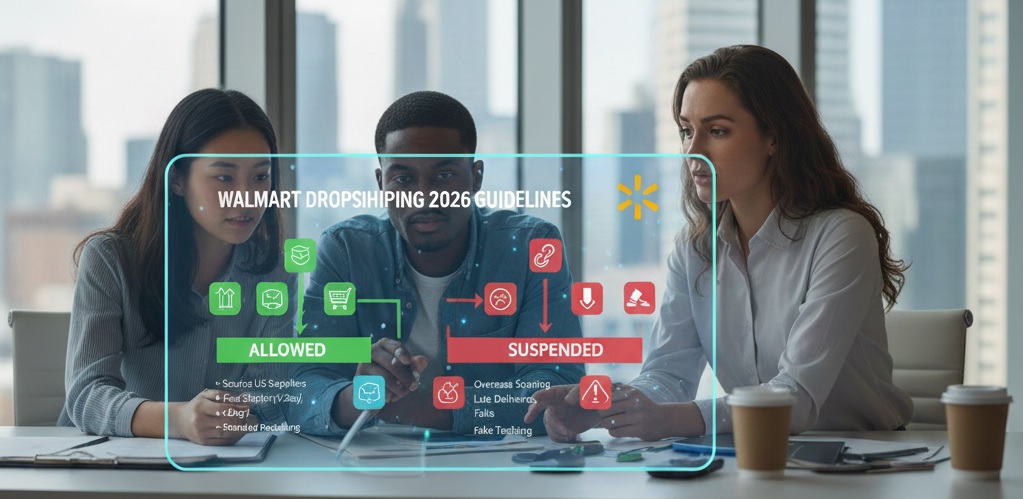
What Gets You Suspended (And How Fast It Happens)
Now for the part that trips up most sellers. These violations can lead to immediate suspension, sometimes without warning.
Using retail stores as suppliers is the biggest mistake I see. Ordering products from Walmart.com, Target, Costco, or any retail site and shipping them to your customers is strictly prohibited. Walmart’s algorithms are built to catch this, and they will.
Supplier-branded packaging is another instant red flag. If your customer receives a package with Amazon tape, AliExpress labels, or any other supplier branding, Walmart considers that a policy violation. The customer should only see neutral or your branded packaging.
Selling restricted or gated products without approval is risky business. Categories like electronics, health supplements, and major branded items often require approval. Jumping into these without authorization will trigger a review—and likely a suspension.
Multiple accounts using the same supplier or warehouse raises fraud concerns. Walmart monitors for this and will shut down accounts that appear to be part of a network designed to bypass rules.
How to Stay Safe and Build a Sustainable Business
Look, I’m not trying to scare you off. Plenty of sellers are crushing it on Walmart while staying fully compliant. You just need to be smart about it.
Work with verified wholesale or distributor suppliers. Build relationships with legitimate suppliers who understand marketplace requirements. Ask for invoices, certifications, and documentation upfront. This protects you if Walmart ever requests proof of authenticity.
Use a 3PL fulfillment center for neutral packaging. A good third-party logistics partner will receive your inventory, store it, and ship orders in plain or branded packaging. This eliminates the supplier packaging issue entirely and gives you more control over the customer experience.
Keep all invoices and documentation for verification. Walmart can request proof of authenticity at any time, especially for branded products or high-value items. Store everything digitally and make it easy to access.
Avoid high-risk categories like electronics, supplements, and branded items. Unless you’re experienced and have proper approval, these categories carry the highest suspension risk. Start with safer, less-regulated products until you’ve built a track record.

Final Thoughts:
Walmart dropshipping in 2026 is absolutely doable—but only if you respect the platform’s rules. The days of cutting corners and hoping for the best are over. Walmart is tightening enforcement, and suspended sellers are learning expensive lessons.
Control your fulfillment process. Work with legitimate suppliers. Keep your documentation tight. Ship on time. Stay out of restricted categories until you’re ready.
Do that, and you’ll build a profitable, sustainable business that doesn’t keep you up at night worrying about account health.
If you’re serious about scaling on Walmart—or any major marketplace—make compliance your foundation. Everything else builds on top of that.